1C3B image
Deposition Date 1999-07-27
Release Date 1999-11-24
Last Version Date 2024-11-13
Entry Detail
PDB ID:
1C3B
Keywords:
Title:
AMPC BETA-LACTAMASE FROM E. COLI COMPLEXED WITH INHIBITOR, BENZO(B)THIOPHENE-2-BORONIC ACID (BZB)
Biological Source:
Source Organism:
Host Organism:
Method Details:
Experimental Method:
Resolution:
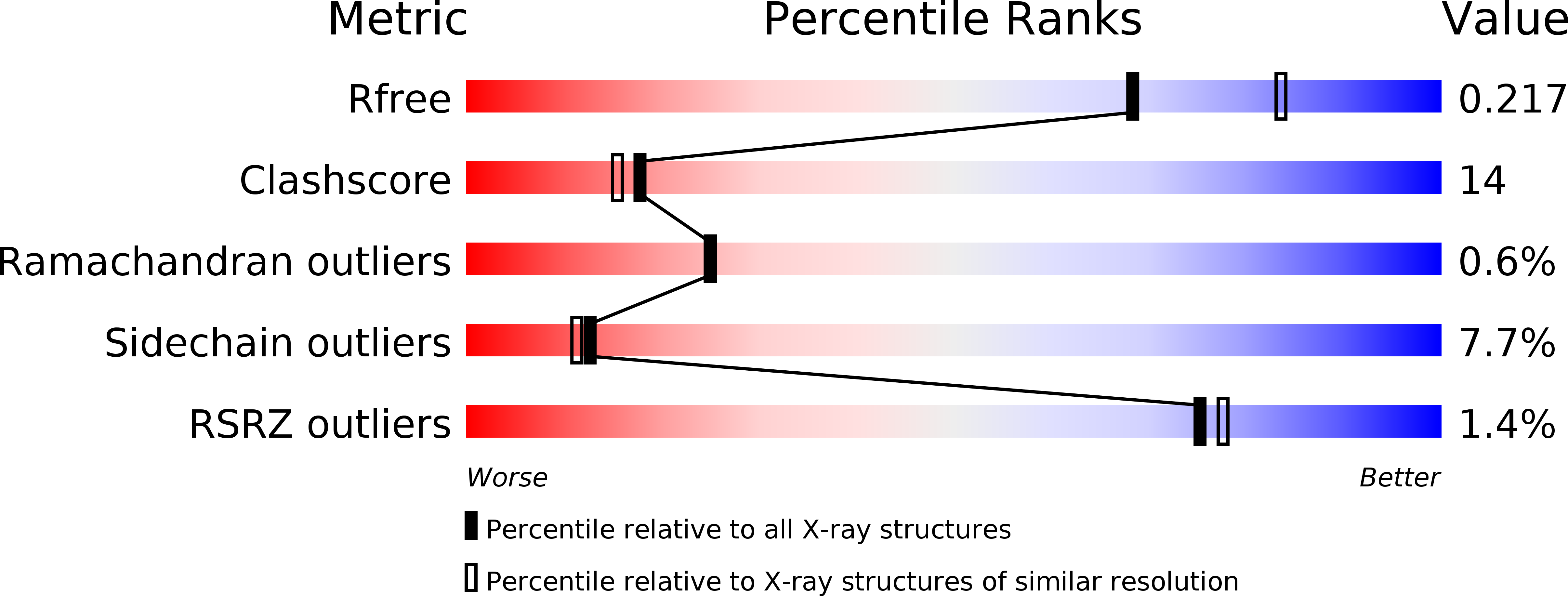
2.25 Å
R-Value Free:
0.22
R-Value Work:
0.16
R-Value Observed:
0.16
Space Group:
C 1 2 1
Macromolecular Entities
Structures with similar UniProt ID
Protein Blast
Polymer Type:polypeptide(L)
Molecule:CEPHALOSPORINASE
Gene (Uniprot):ampC
Chain IDs:A, B
Chain Length:358
Number of Molecules:2
Biological Source:Escherichia coli
Ligand Molecules
Primary Citation
The complexed structure and antimicrobial activity of a non-beta-lactam inhibitor of AmpC beta-lactamase.
Protein Sci. 8 2330 2337 (1999)
PMID: 10595535

Abstact

Beta-lactamases are the major resistance mechanism to beta-lactam antibiotics and pose a growing threat to public health. Recently, bacteria have become resistant to beta-lactamase inhibitors, making this problem pressing. In an effort to overcome this resistance, non-beta-lactam inhibitors of beta-lactamases were investigated for complementarity to the structure of AmpC beta-lactamase from Escherichia coli. This led to the discovery of an inhibitor, benzo(b)thiophene-2-boronic acid (BZBTH2B), which inhibited AmpC with a Ki of 27 nM. This inhibitor is chemically dissimilar to beta-lactams, raising the question of what specific interactions are responsible for its activity. To answer this question, the X-ray crystallographic structure of BZBTH2B in complex with AmpC was determined to 2.25 A resolution. The structure reveals several unexpected interactions. The inhibitor appears to complement the conserved, R1-amide binding region of AmpC, despite lacking an amide group. Interactions between one of the boronic acid oxygen atoms, Tyr150, and an ordered water molecule suggest a mechanism for acid/base catalysis and a direction for hydrolytic attack in the enzyme catalyzed reaction. To investigate how a non-beta-lactam inhibitor would perform against resistant bacteria, BZBTH2B was tested in antimicrobial assays. BZBTH2B significantly potentiated the activity of a third-generation cephalosporin against AmpC-producing resistant bacteria. This inhibitor was unaffected by two common resistance mechanisms that often arise against beta-lactams in conjunction with beta-lactamases. Porin channel mutations did not decrease the efficacy of BZBTH2B against cells expressing AmpC. Also, this inhibitor did not induce expression of AmpC, a problem with many beta-lactams. The structure of the BZBTH2B/AmpC complex provides a starting point for the structure-based elaboration of this class of non-beta-lactam inhibitors.

Legend

Protein

Chemical

Disease

Primary Citation of related structures
Feedback Form
Name
Email
Institute
Feedback