1BZQ image
Deposition Date 1998-11-03
Release Date 1998-11-11
Last Version Date 2024-11-06
Entry Detail
PDB ID:
1BZQ
Title:
COMPLEX OF A DROMEDARY SINGLE-DOMAIN VHH ANTIBODY FRAGMENT WITH RNASE A
Biological Source:
Source Organism:
Camelus dromedarius (Taxon ID: 9838)
Bos taurus (Taxon ID: 9913)
Host Organism:
Method Details:
Experimental Method:
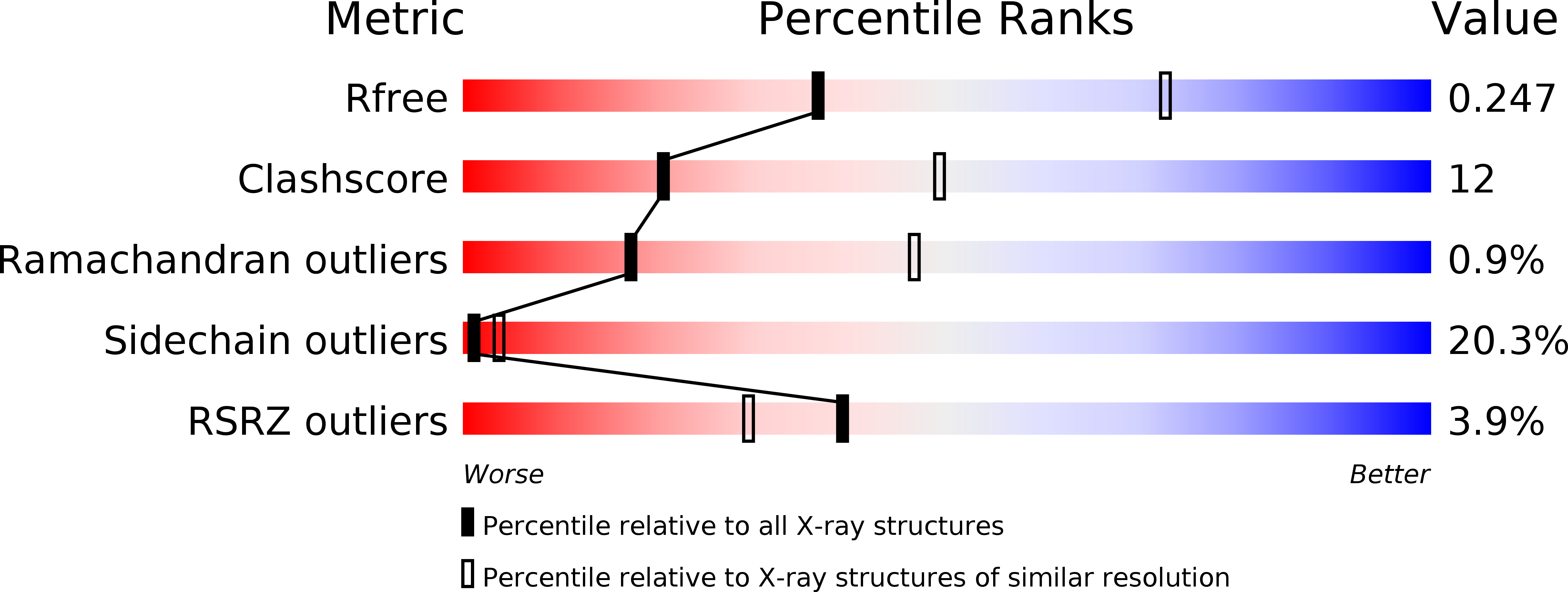
Resolution:
2.80 Å
R-Value Free:
0.28
R-Value Work:
0.22
Space Group:
P 1
Macromolecular Entities
Structures with similar UniProt ID
Protein Blast
Polymer Type:polypeptide(L)
Molecule:PROTEIN (RNASE A)
Gene (Uniprot):RNASE1
Chain IDs:A, B, C, D
Chain Length:124
Number of Molecules:4
Biological Source:Bos taurus
Polymer Type:polypeptide(L)
Molecule:PROTEIN (ANTIBODY CAB-RN05)
Chain IDs:E (auth: K), F (auth: L), G (auth: M), H (auth: N)
Chain Length:124
Number of Molecules:4
Biological Source:Camelus dromedarius
Ligand Molecules
Primary Citation
A single-domain antibody fragment in complex with RNase A: non-canonical loop structures and nanomolar affinity using two CDR loops.
Structure Fold.Des. 7 361 370 (1999)
PMID: 10196124 DOI: 10.1016/S0969-2126(99)80049-5

Abstact

BACKGROUND: Camelid serum contains a large fraction of functional heavy-chain antibodies - homodimers of heavy chains without light chains. The variable domains of these heavy-chain antibodies (VHH) have a long complementarity determining region 3 (CDR3) loop that compensates for the absence of the antigen-binding loops of the variable light chains (VL). In the case of the VHH fragment cAb-Lys3, part of the 24 amino acid long CDR3 loop protrudes from the antigen-binding surface and inserts into the active-site cleft of its antigen, rendering cAb-Lys3 a competitive enzyme inhibitor. RESULTS: A dromedary VHH with specificity for bovine RNase A, cAb-RN05, has a short CDR3 loop of 12 amino acids and is not a competitive enzyme inhibitor. The structure of the cAb-RN05-RNase A complex has been solved at 2.8 A. The VHH scaffold architecture is close to that of a human VH (variable heavy chain). The structure of the antigen-binding hypervariable 1 loop (H1) of both cAb-RN05 and cAb-Lys3 differ from the known canonical structures; in addition these H1 loops resemble each other. The CDR3 provides an antigen-binding surface and shields the face of the domain that interacts with VL in conventional antibodies. CONCLUSIONS: VHHs adopt the common immunoglobulin fold of variable domains, but the antigen-binding loops deviate from the predicted canonical structure. We define a new canonical structure for the H1 loop of immunoglobulins, with cAb-RN05 and cAb-Lys3 as reference structures. This new loop structure might also occur in human or mouse VH domains. Surprisingly, only two loops are involved in antigen recognition; the CDR2 does not participate. Nevertheless, the antigen binding occurs with nanomolar affinities because of a preferential usage of mainchain atoms for antigen interaction.

Legend

Protein

Chemical

Disease

Primary Citation of related structures
Feedback Form
Name
Email
Institute
Feedback