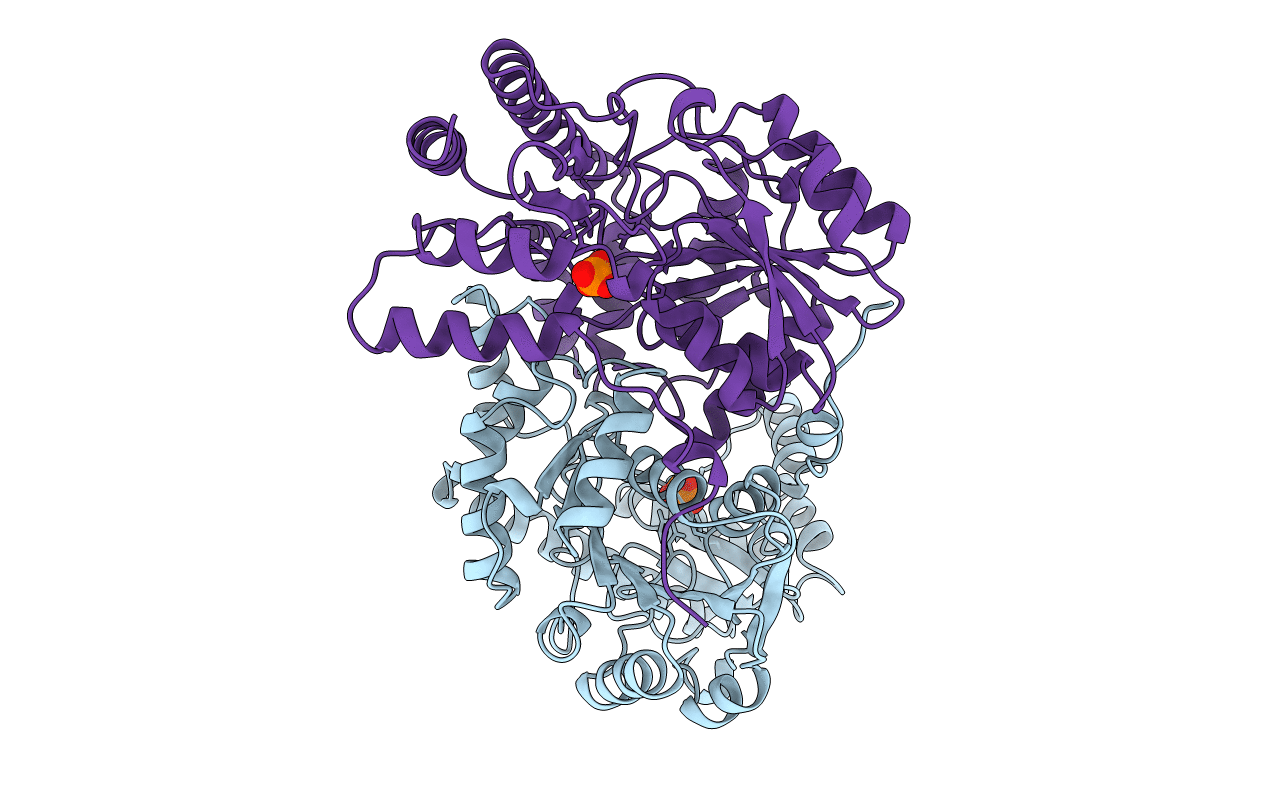
1BJW image
Deposition Date 1998-06-30
Release Date 1999-07-22
Last Version Date 2024-06-05
Entry Detail
PDB ID:
1BJW
Title:
ASPARTATE AMINOTRANSFERASE FROM THERMUS THERMOPHILUS
Biological Source:
Source Organism:
Host Organism:
Method Details:
Experimental Method:
Resolution:
1.80 Å
R-Value Free:
0.26
R-Value Work:
0.21
R-Value Observed:
0.21
Space Group:
P 21 21 21

Macromolecular Entities
Structures with similar UniProt ID
Protein Blast
Polymer Type:polypeptide(L)
Molecule:ASPARTATE AMINOTRANSFERASE
Gene (Uniprot):aspC
Chain IDs:A, B
Chain Length:382
Number of Molecules:2
Biological Source:Thermus thermophilus
Modified Residue
Compound ID Chain ID Parent Comp ID Details 2D Image
LLP A LYS ?
Ligand Molecules
Primary Citation
Structure of Thermus thermophilus HB8 aspartate aminotransferase and its complex with maleate.
Biochemistry 38 2413 2424 (1999)
PMID: 10029535 DOI: 10.1021/bi9819881

Abstact

The three-dimensional structures of pyridoxal 5'-phosphate-type aspartate aminotransferase (AspAT) from Thermus thermophilus HB8 and pyridoxamine 5'-phosphate type one in complex with maleate have been determined by X-ray crystallography at 1.8 and 2.6 A resolution, respectively. The enzyme is a homodimer, and the polypeptide chain of the subunit is folded into one arm, one small domain, and one large domain. AspATs from many species were classified into aminotransferase subgroups Ia and Ib. The enzyme belongs to subgroup Ib, its sequence being less than 16% identical to the primary sequences of Escherichia coli, pig cytosolic, and chicken mitochondrial AspATs, which belong to subgroup Ia whose sequences are more than 40% identical and whose three-dimensional structures are quite similar with the active site residues almost completely conserved. The first X-ray analysis of AspAT subgroup Ib indicated that the overall and the active site structures are essentially conserved between the AspATs of subgroup Ia and the enzyme of subgroup Ib, but there are two distinct differences between them. (1) In AspAT subgroup Ia, substrate (or inhibitor) binding induces a large movement of the small domain as a whole to close the active site. However, in the enzyme of subgroup Ib, only the N-terminal region (Lys13-Val30) of the small domain approaches the active site to interact with the maleate. (2) In AspAT subgroup Ia, Arg292 recognizes the side chain carboxylate of the substrate; however, residue 292 of the enzyme in subgroup Ib is not Arg, and in place of Arg292, Lys109 forms a salt bridge with the side chain carboxylate. The thermostability of the enzyme is attained at least in part by the high content of Pro residues in the beta-turns and the marked increase in the number of salt bridges on the molecular surface compared with the mesophilic AspAT.

Legend

Protein

Chemical

Disease

Primary Citation of related structures
Feedback Form
Name
Email
Institute
Feedback