Planned Maintenance: Some services may turn out to be unavailable from 15th January, 2026 to 16th January, 2026. We apologize for the inconvenience!

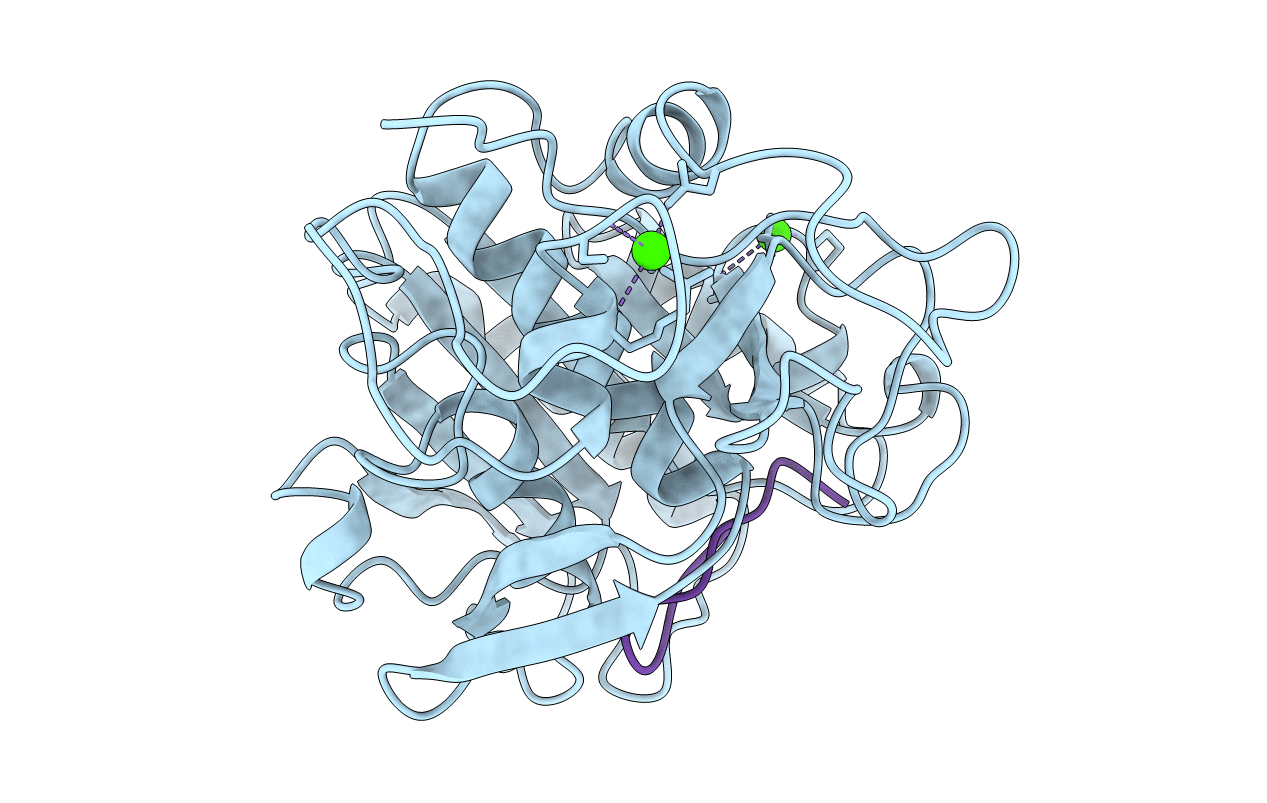
1BJR image
Deposition Date 1998-06-27
Release Date 1998-11-04
Last Version Date 2024-11-20
Entry Detail
PDB ID:
1BJR
Title:
COMPLEX FORMED BETWEEN PROTEOLYTICALLY GENERATED LACTOFERRIN FRAGMENT AND PROTEINASE K
Biological Source:
Source Organism(s):
Method Details:
Experimental Method:
Resolution:
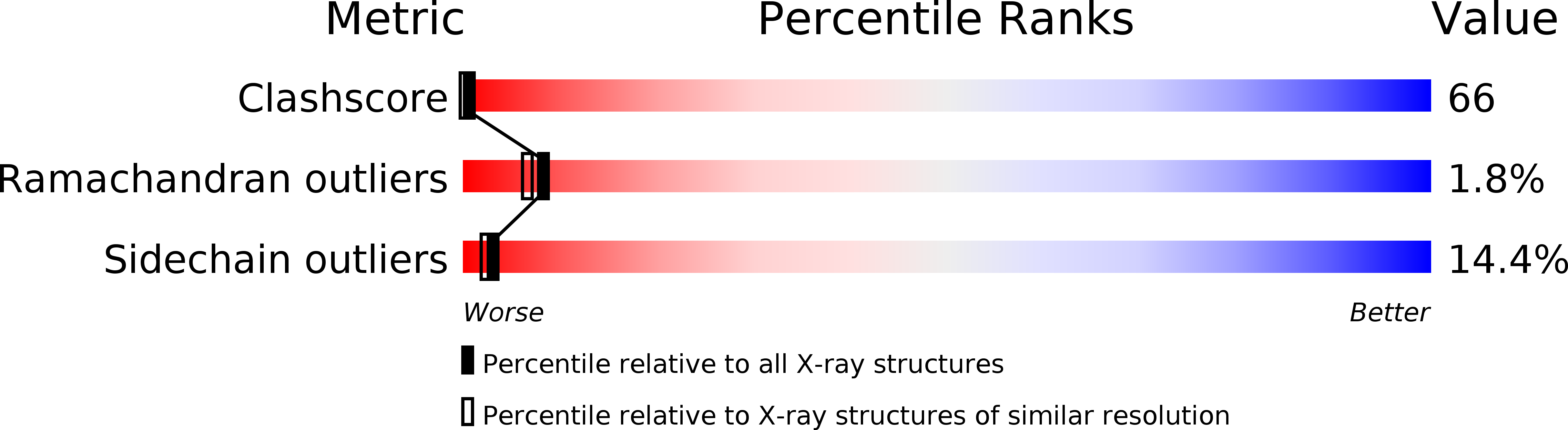
2.44 Å
R-Value Free:
0.22
R-Value Work:
0.16
R-Value Observed:
0.16
Space Group:
P 1 21 1
Macromolecular Entities
Structures with similar UniProt ID
Protein Blast
Polymer Type:polypeptide(L)
Molecule:PROTEINASE K
Gene (Uniprot):PROK
Chain IDs:A (auth: E)
Chain Length:279
Number of Molecules:1
Biological Source:Engyodontium album
Polymer Type:polypeptide(L)
Molecule:LACTOFERRIN
Chain IDs:B (auth: I)
Chain Length:10
Number of Molecules:1
Biological Source:Bubalus bubalis
Ligand Molecules
Primary Citation
Crystal structure of a complex formed between proteolytically-generated lactoferrin fragment and proteinase K.
Proteins 33 30 38 (1998)
PMID: 9741842 DOI: 10.1002/(SICI)1097-0134(19981001)33:1<30::AID-PROT3>3.3.CO;2-W

Abstact

Lactoferrin is an iron binding glycoprotein with a molecular weight of 80 kDa. The molecule is divided into two lobes representing the N-terminal and C-terminal halves of the polypeptide chain, each containing an iron binding site. The serine proteinases such as trypsin, chymotrypsin, and pepsin hydrolyze lactoferrin into two unequal halves while proteinase K divides this protein into two equal halves. In the first step of hydrolysis by proteinase K, the C- and N-lobes, each having a molecular weight of approximately 40 kDa, are generated. In the next step, the lobes are further hydrolyzed into small molecular weight peptides. The proteinase K isolated from the hydrolyzed product does not show enzymatic activity suggesting that the enzyme is inhibited. Furthermore, the hydrolysis experiments on N-lobe and C-lobe showed that the inhibitory fragment came from the C-lobe. The purified lactoferrin fragment was found to be a decapeptide with an amino acid sequence of H2N-Val-Ala-Gln-Gly-Ala-Ala-Gly-Leu-Ala-COOH. The complex formed between proteinase K and lactoferrin fragment was crystallized by microdialysis. The crystals belonged to the monoclinic space group P2(1) with cell dimensions a = 44.4 A, b = 38.6 A, c = 79.2 A, beta = 105.8 degrees and Z = 2. The crystal structure has been determined at 2.4 A resolution. It has been refined to an R factor of 0.163 for 9044 reflections. The Lf-fragment forms several intermolecular interactions with proteinase K. The Ser-224 Ogamma and His-57 N epsilon2 move away to a distance of 3.68 A in the complex. In the crystal structure, Gln-3I (I indicates inhibitor i.e., lactoferrin fragment) is involved in a direct intermolecular interaction with a symmetry related proteinase K molecule through a strong hydrogen bond with Asp-254. The mode of intermolecular interactions in the complex conformational features of the enzyme and placement of the fragment with respect to the enzyme resemble with the molecular complex of proteinase K with its natural inhibitor PKI3 from wheat.

Legend

Protein

Chemical

Disease

Primary Citation of related structures
Feedback Form
Name
Email
Institute
Feedback