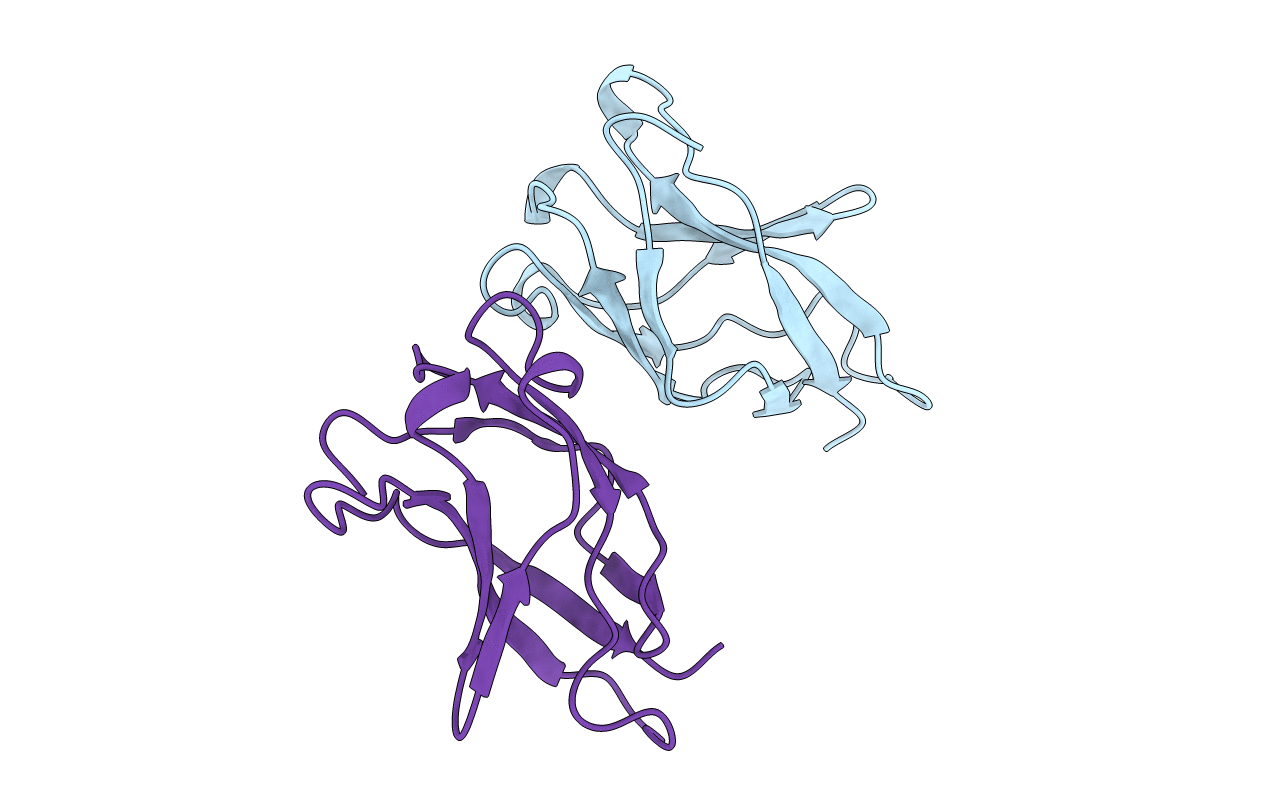
1BFT image
Deposition Date 1997-09-12
Release Date 1998-01-28
Last Version Date 2025-02-26
Entry Detail
PDB ID:
1BFT
Title:
STRUCTURE OF NF-KB P65 HOMODIMER BOUND TO A KB SITE
Biological Source:
Source Organism:
Mus musculus (Taxon ID: 10090)
Method Details:
Experimental Method:
Resolution:
2.00 Å
R-Value Free:
0.29
R-Value Work:
0.20
R-Value Observed:
0.20
Space Group:
C 2 2 21

Macromolecular Entities
Structures with similar UniProt ID
Protein Blast
Polymer Type:polypeptide(L)
Molecule:NUCLEAR FACTOR NF-KAPPA-B P65
Gene (Uniprot):Rela
Chain IDs:A, B
Chain Length:101
Number of Molecules:2
Biological Source:Mus musculus
Primary Citation
The role of DNA in the mechanism of NFkappaB dimer formation: crystal structures of the dimerization domains of the p50 and p65 subunits.
Structure 5 1427 1436 (1997)
PMID: 9384558 DOI: 10.1016/S0969-2126(97)00293-1

Abstact

BACKGROUND Members of the rel/NFkappaB family of transcription factors play a vital role in the regulation of rapid cellular responses, such as those required to fight infection or react to cellular stress. Members of this family of proteins form homo- and heterodimers with differing affinities for dimerization. They share a structural motif known as the rel homology region (RHR), the C-terminal one third of which mediates protein dimerization. Crystal structures of the rel/NFkappaB family members p50 and p65 in their DNA-bound homodimeric form have been solved. These structures showed that the residues from the dimerization domains of both p50 and p65 participate in DNA binding and that the DNA-protein and protein dimerization surfaces form one continuous overlapping interface. We desired to investigate the contribution of DNA to NFkappaB dimerization and to identify the mechanism for the selective association of rel/NFkappaB family peptides into transcriptionally active dimers. RESULTS We report here the crystal structures of the dimerization domains of murine p50 and p65 at 2.2 A and 2.0 A resolution, respectively. A comparison of these two structures suggests that conservative amino acid changes at three positions are responsible for the differences in their dimer interfaces. The presence of the target DNA does not change the dimer interface of either protein in any significant manner. CONCLUSIONS These two structures suggest that the rel/NFkappaB family of transcription factors use only a few conservative changes in their amino acid sequences to form a host of dimers with varying affinities for dimerization. Amino acids at positions corresponding to 254, 267, and 307 of murine p50, function as primary determinants for the observed differences in dimerization affinity. The DNA-contacting charged amino acid sidechains from the dimerization domains are held in a similar conformation in both the DNA-bound and free states, therefore, no major structural rearrangement is required to bring these residues into contact with the DNA.

Legend

Protein

Chemical

Disease

Primary Citation of related structures
Feedback Form
Name
Email
Institute
Feedback