1B4W image
Deposition Date 1998-12-30
Release Date 2000-01-12
Last Version Date 2024-10-16
Entry Detail
PDB ID:
1B4W
Keywords:
Title:
BASIC PHOSPHOLIPASE A2 FROM AGKISTRODON HALYS PALLAS-IMPLICATIONS FOR ITS ASSOCIATION AND ANTICOAGULANT ACTIVITIES BY X-RAY CRYSTALLOGRAPHY
Biological Source:
Source Organism:
Gloydius halys (Taxon ID: 8714)
Method Details:
Experimental Method:
Resolution:
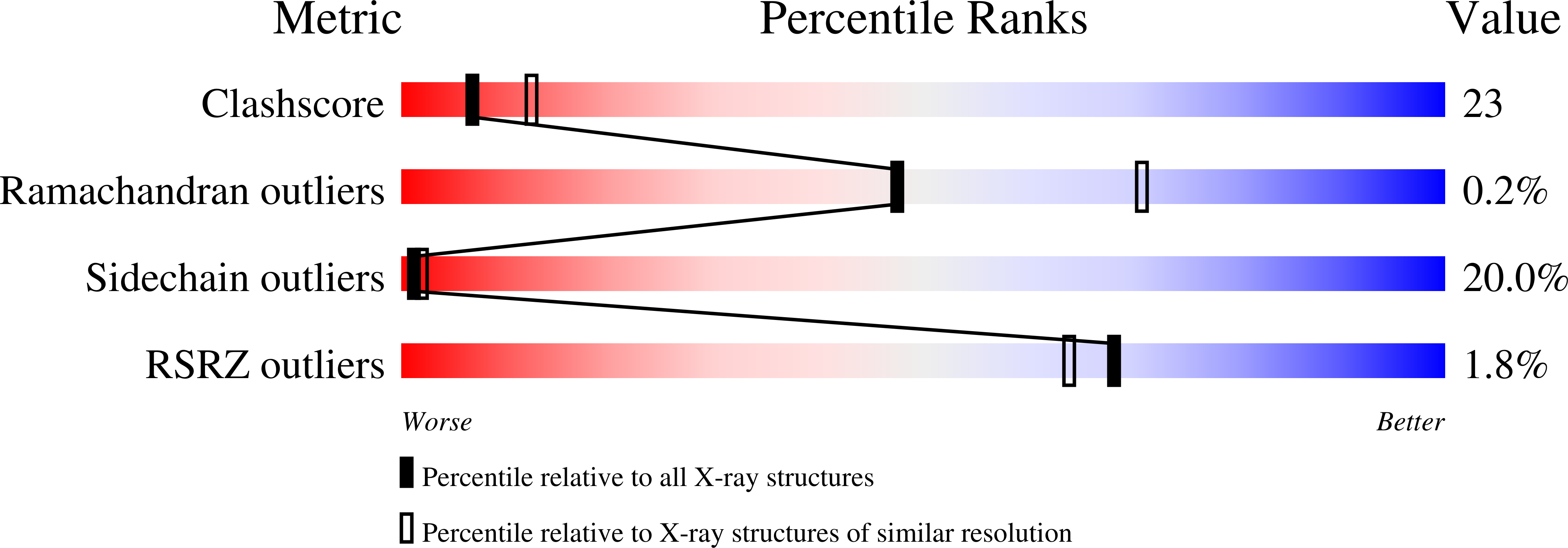
2.60 Å
R-Value Free:
0.28
R-Value Work:
0.20
R-Value Observed:
0.20
Space Group:
C 1 2 1
Macromolecular Entities
Structures with similar UniProt ID
Protein Blast
Polymer Type:polypeptide(L)
Molecule:PROTEIN (PHOSPHOLIPASE A2)
Chain IDs:A, B, C, D
Chain Length:122
Number of Molecules:4
Biological Source:Gloydius halys
Ligand Molecules
Primary Citation
Structure of basic phospholipase A2 from Agkistrodon halys Pallas: implications for its association, hemolytic and anticoagulant activities.
Toxicon 38 901 916 (2000)
PMID: 10728829 DOI: 10.1016/S0041-0101(99)00193-2

Abstact

The basic phospholipase A2 (PLA2) from the venom of Agkistrodon halys Pallas is a potent hemolytic toxin and anticoagulant. Crystal structure of the enzyme complexed with detergent n-octyl beta-D-glucopyranoside (beta-OG) in monoclinic crystal form has been determined to 2.6 A resolution. Beta-OG molecules were found in the hydrophobic channels of the enzyme. SDS-PAGE and dynamic light scattering measurements showed that the enzyme had a strong tendency to dimerise in aqueous solution. In the crystal structure the enzyme molecules associate into a tetramer with pseudo 222 symmetry, and the interfacial recognition site linked dimers constituting the tetramer have intensive interface interactions, and may be stable in solution. The structure reveals a unique positively charged face at the C-terminal region and a characteristic non-cationic 'anticoagulant' region (53-77). The face is supposed to be the hemolytic site, and based on sequence and structure comparison residues Trp70 and Glu53 instead of the basic residues in 'anticoagulant' region might play an important role in the anticoagulant activity.

Legend

Protein

Chemical

Disease

Primary Citation of related structures
Feedback Form
Name
Email
Institute
Feedback