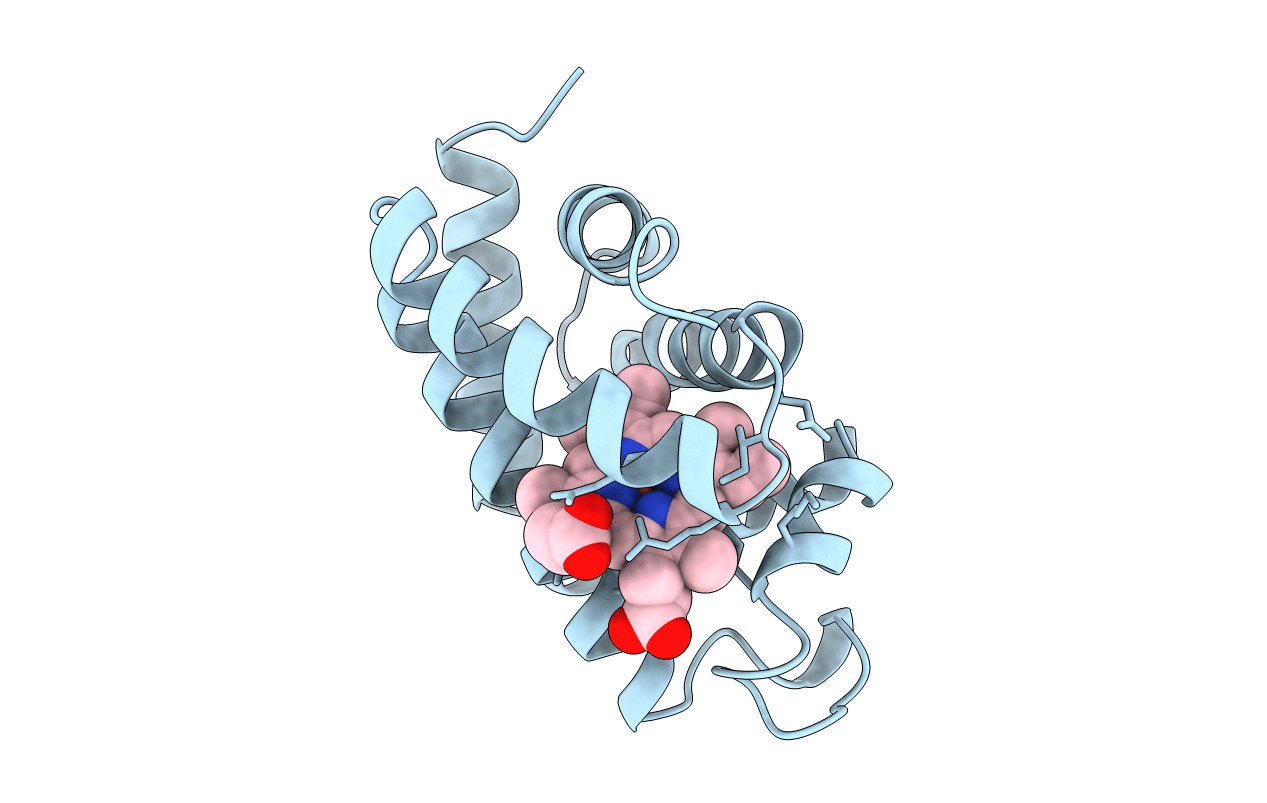
1B0B image
Deposition Date 1998-11-06
Release Date 2000-02-18
Last Version Date 2024-06-05
Entry Detail
PDB ID:
1B0B
Title:
HEMOGLOBIN I FROM THE CLAM LUCINA PECTINATA, CYANIDE COMPLEX AT 100 KELVIN
Biological Source:
Source Organism:
Method Details:
Experimental Method:
Resolution:
1.43 Å
R-Value Free:
0.16
R-Value Observed:
0.11
Space Group:
P 1 21 1

Macromolecular Entities
Structures with similar UniProt ID
Protein Blast
Polymer Type:polypeptide(L)
Molecule:HEMOGLOBIN
Chain IDs:A
Chain Length:142
Number of Molecules:1
Biological Source:Lucina pectinata
Modified Residue
Compound ID Chain ID Parent Comp ID Details 2D Image
SAC A SER N-ACETYL-SERINE
Primary Citation
Cyanide binding to Lucina pectinata hemoglobin I and to sperm whale myoglobin: an x-ray crystallographic study.
Biophys.J. 77 1093 1099 (1999)
PMID: 10423453

Abstact

The x-ray crystal structures of the cyanide derivative of Lucina pectinata monomeric hemoglobin I (L. pectinata HbI) and sperm whale (Physeter catodon) myoglobin (Mb), generally taken as reference models for monomeric hemoproteins carrying hydrogen sulfide and oxygen, respectively, have been determined at 1.9 A (R-factor = 0. 184), and 1.8 A (R-factor = 0.181) resolution, respectively, at room temperature (lambda = 1.542 A). Moreover, the x-ray crystal structure of the L. pectinata HbI:cyanide derivative has been studied at 1.4-A resolution (R-factor = 0.118) and 100 K (on a synchrotron source lambda = 0.998 A). At room temperature, the cyanide ligand is roughly parallel to the heme plane of L. pectinata HbI, being located approximately 2.5 A from the iron atom. On the other hand, the crystal structure of the L. pectinata HbI:cyanide derivative at 100 K shows that the diatomic ligand is coordinated to the iron atom in an orientation almost perpendicular to the heme (the Fe-C distance being 1.95 A), adopting a coordination geometry strictly reminescent of that observed in sperm whale Mb, at room temperature. The unusual cyanide distal site orientation observed in L. pectinata HbI, at room temperature, may reflect reduction of the heme Fe(III) atom induced by free radical species during x-ray data collection using Cu Kalpha radiation.

Legend

Protein

Chemical

Disease

Primary Citation of related structures
Feedback Form
Name
Email
Institute
Feedback