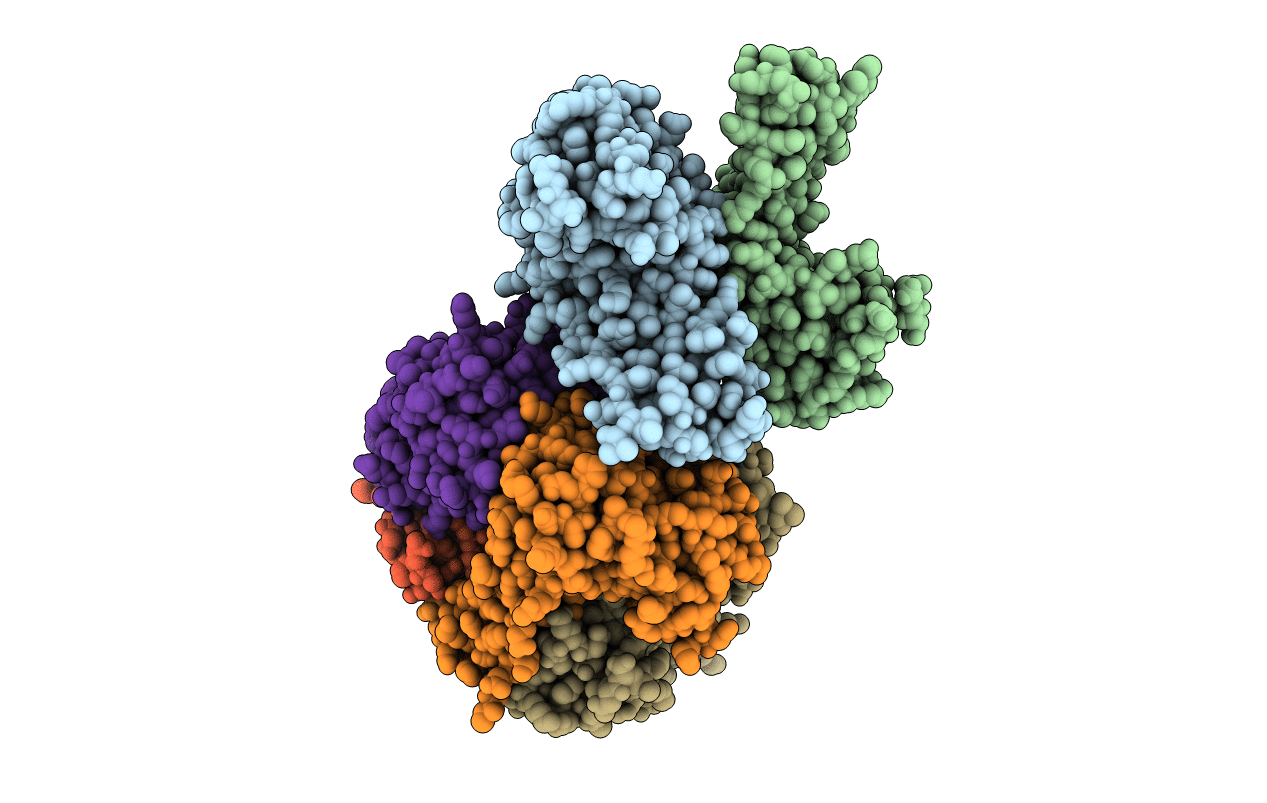
1B06 image
Deposition Date 1998-11-16
Release Date 1999-11-18
Last Version Date 2023-12-27
Entry Detail
PDB ID:
1B06
Keywords:
Title:
SUPEROXIDE DISMUTASE FROM SULFOLOBUS ACIDOCALDARIUS
Biological Source:
Source Organism:
Method Details:
Experimental Method:
Resolution:
2.20 Å
R-Value Free:
0.22
R-Value Work:
0.17
R-Value Observed:
0.17
Space Group:
C 1 2 1

Macromolecular Entities
Structures with similar UniProt ID
Protein Blast
Polymer Type:polypeptide(L)
Molecule:PROTEIN (SUPEROXIDE DISMUTASE)
Gene (Uniprot):sod
Chain IDs:A, B, C, D, E, F
Chain Length:210
Number of Molecules:6
Biological Source:Sulfolobus acidocaldarius
Ligand Molecules
Primary Citation
Refined crystal structure of a superoxide dismutase from the hyperthermophilic archaeon Sulfolobus acidocaldarius at 2.2 A resolution.
J.Mol.Biol. 285 689 702 (1999)
PMID: 9878438 DOI: 10.1006/jmbi.1998.2344

Abstact

The extremely thermostable superoxide dismutase from the hyperthermophilic archaeon Sulfolobus acidocaldarius was crystallized and the three-dimensional structure was determined by X-ray diffraction methods. The enzyme crystallized in the monoclinic spacegroup C2 with the cell dimensions a=168.1 A, b=91.3 A, c=85.7 A, beta=91.4 degrees. The diffraction limit of these crystals was 2.2 A. The crystals were very stable in the X-ray beam and measured diffraction data of a single crystal had a completeness of 99.5 % up to a resolution of 2.2 A. The crystal structure of S. acidocaldarius superoxide dismutase was solved by Patterson search methods using a dimer of Thermus thermophilus superoxide dismutase as a search model. The asymmetric unit accommodates three dimers. Two dimers form a tetramer by using only local symmetries; the third dimer forms a tetramer as well, however, by using the crystallographic 2-fold symmetry. The three-dimensional structure of the S. acidocaldarius dismutase has typical features of tetrameric dismutases. Secondary structure elements as well as residues important for the catalytic activity of the enzyme were found to be highly conserved. The model was refined at a resolution of 2.2 A and yielded a crystallographic R-value of 17.4 % (Rfree=22.3 %). A structural comparison of the two extremely stable tetrameric dismutases from S. acidocaldarius and Aquifex pyrophilus with the less stable enzyme from T. thermophilus and Mycoplasma tuberculosis revealed the structural determinants which are probably responsible for the high intrinsic stability of S. acidocaldarius dismutase. The most obvious factor which may give rise to the extraordinary thermal stability of S. acidocaldarius dismutase (melting temperature of about 125 degreesC) is the increase in intersubunit ion pairs and hydrogen bonds and, more importantly, the significant reduction of solvent-accessible hydrophobic surfaces, as well as an increase in the percentage of buried hydrophobic residues.

Legend

Protein

Chemical

Disease

Primary Citation of related structures
Feedback Form
Name
Email
Institute
Feedback