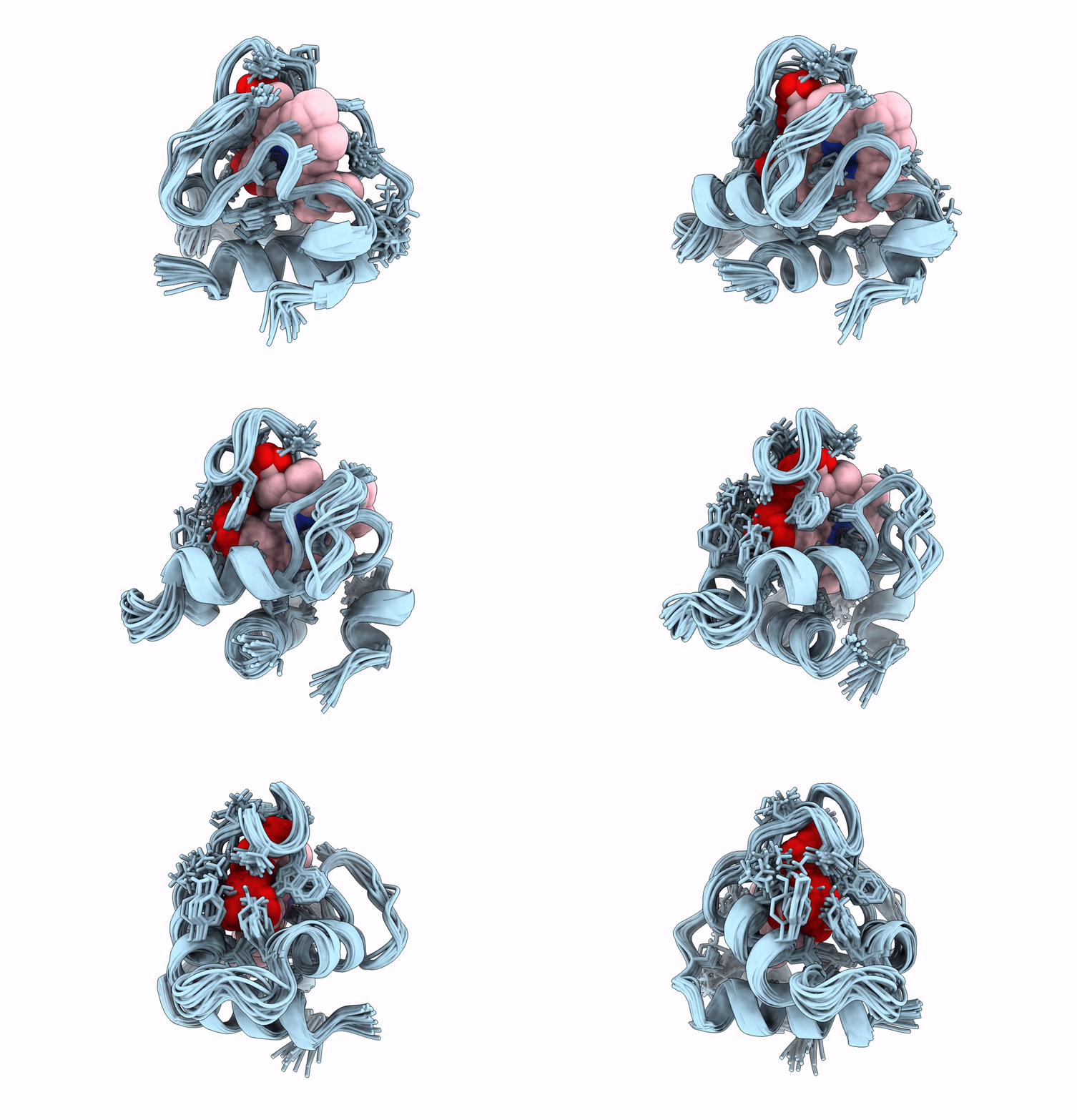
1AYG image
Deposition Date 1997-11-04
Release Date 1998-11-25
Last Version Date 2024-10-09
Entry Detail
PDB ID:
1AYG
Title:
SOLUTION STRUCTURE OF CYTOCHROME C-552, NMR, 20 STRUCTURES
Biological Source:
Source Organism(s):
Method Details:
Experimental Method:
Conformers Calculated:
100
Conformers Submitted:
20
Selection Criteria:
LOWER ENERGY

Macromolecular Entities
Structures with similar UniProt ID
Protein Blast
Polymer Type:polypeptide(L)
Molecule:CYTOCHROME C-552
Gene (Uniprot):HTH_0988, Hydth_0984
Chain IDs:A
Chain Length:80
Number of Molecules:1
Biological Source:Hydrogenobacter thermophilus
Ligand Molecules
Primary Citation
Solution structure of thermostable cytochrome c-552 from Hydrogenobacter thermophilus determined by 1H-NMR spectroscopy.
Biochemistry 37 9641 9649 (1998)
PMID: 9657676 DOI: 10.1021/bi9803067

Abstact

The solution structure of a thermostable cytochrome c-552 from a thermophilic hydrogen oxidizing bacterium Hydrogenobacter thermophilus was determined by proton nuclear magnetic resonance spectroscopy. Twenty structures were calculated by the X-PLOR program on the basis of 902 interproton distances, 21 hydrogen bonds, and 13 torsion angle constraints. The pairwise average root-mean-square deviation for the main chain heavy atoms was 0.91 +/- 0.11 A. The main chain folding of the cytochrome c-552 was almost the same as that of Pseudomonas aeruginosa cytochrome c-551 that has 59% sequence identity to the cytochrome c-552 but is less thermostable. We found several differences in local structures between the cytochromes c-552 and c-551. In the cytochrome c-552, aromatic-amino interactions were uniquely formed between Arg 35 and Tyr 32 and/or Tyr 41, the latter also having hydrophobic contacts with the side chains of Tyr 32, Ala 38, and Leu 42. Small hydrophobic cores were more tightly packed in the cytochrome c-552 because of the occupancies of Ala 5, Met 11, and Ile 76, each substituted by Phe 7, Val 13, and Val 78, respectively, in the cytochrome c-551. Some of these structural differences may contribute to the higher thermostability of the cytochrome c-552.

Legend

Protein

Chemical

Disease

Primary Citation of related structures
Feedback Form
Name
Email
Institute
Feedback