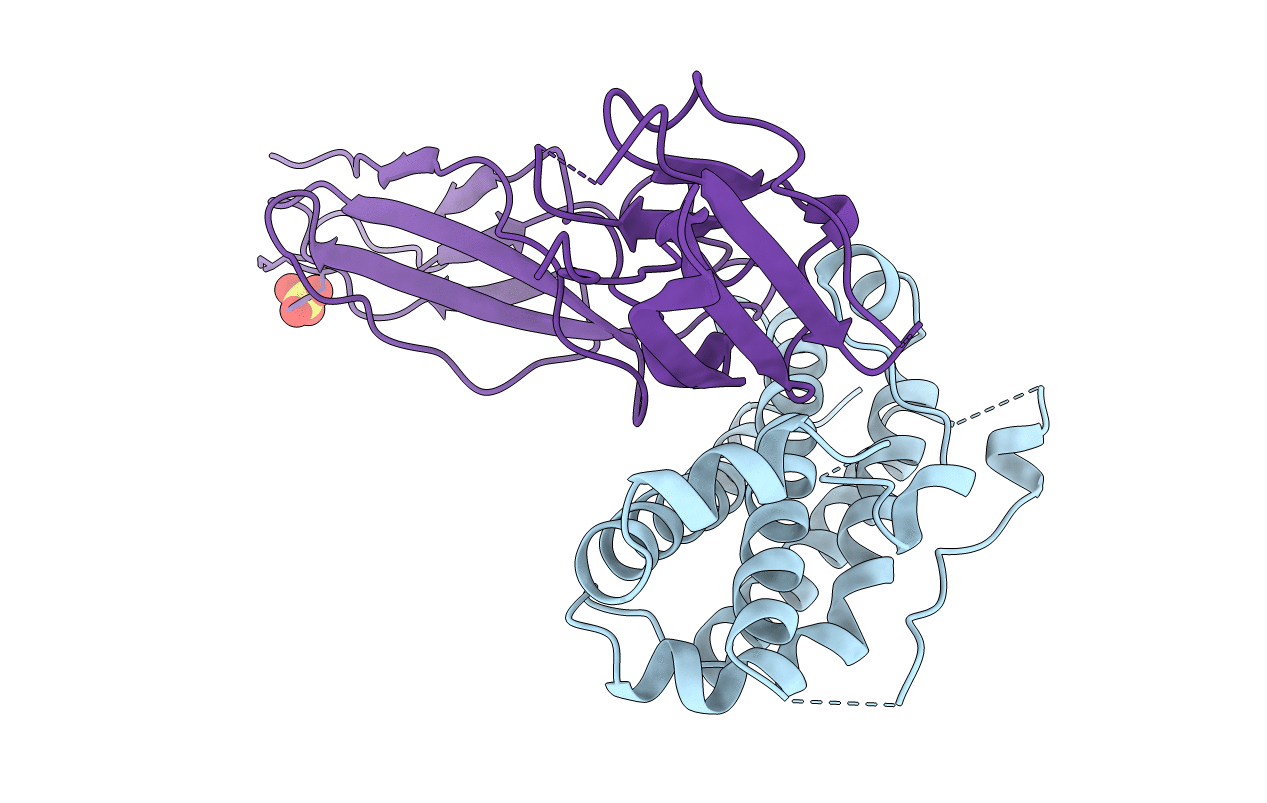
1AXI image
Deposition Date 1997-10-15
Release Date 1998-01-28
Last Version Date 2024-11-20
Entry Detail
PDB ID:
1AXI
Title:
STRUCTURAL PLASTICITY AT THE HGH:HGHBP INTERFACE
Biological Source:
Source Organism:
Homo sapiens (Taxon ID: 9606)
Host Organism:
Method Details:
Experimental Method:
Resolution:
2.10 Å
R-Value Free:
0.26
R-Value Work:
0.19
Space Group:
P 43 21 2

Macromolecular Entities
Structures with similar UniProt ID
Protein Blast
Polymer Type:polypeptide(L)
Molecule:GROWTH HORMONE
Gene (Uniprot):GH1
Mutagens:G120R, K168R, D171T, K172Y, E174A, F176Y
Chain IDs:A
Chain Length:191
Number of Molecules:1
Biological Source:Homo sapiens
Structures with similar UniProt ID
Protein Blast
Polymer Type:polypeptide(L)
Molecule:GROWTH HORMONE RECEPTOR
Gene (Uniprot):GHR
Mutagens:W104A
Chain IDs:B
Chain Length:236
Number of Molecules:1
Biological Source:Homo sapiens
Ligand Molecules
Primary Citation
Structural plasticity in a remodeled protein-protein interface.
Science 278 1125 1128 (1997)
PMID: 9353194 DOI: 10.1126/science.278.5340.1125

Abstact

Remodeling of the interface between human growth hormone (hGH) and the extracellular domain of its receptor was studied by deleting a critical tryptophan residue (at position 104) in the receptor, creating a large cavity, and selecting a pentamutant of hGH by phage display that fills the cavity and largely restores binding affinity. A 2.1 A resolution x-ray structure of the mutant complex showed that the receptor cavity was filled by selected hydrophobic mutations of hGH. Large structural rearrangements occurred in the interface at sites that were distant from the mutations. Such plasticity may be a means for protein-protein interfaces to adapt to mutations as they coevolve.

Legend

Protein

Chemical

Disease

Primary Citation of related structures
Feedback Form
Name
Email
Institute
Feedback