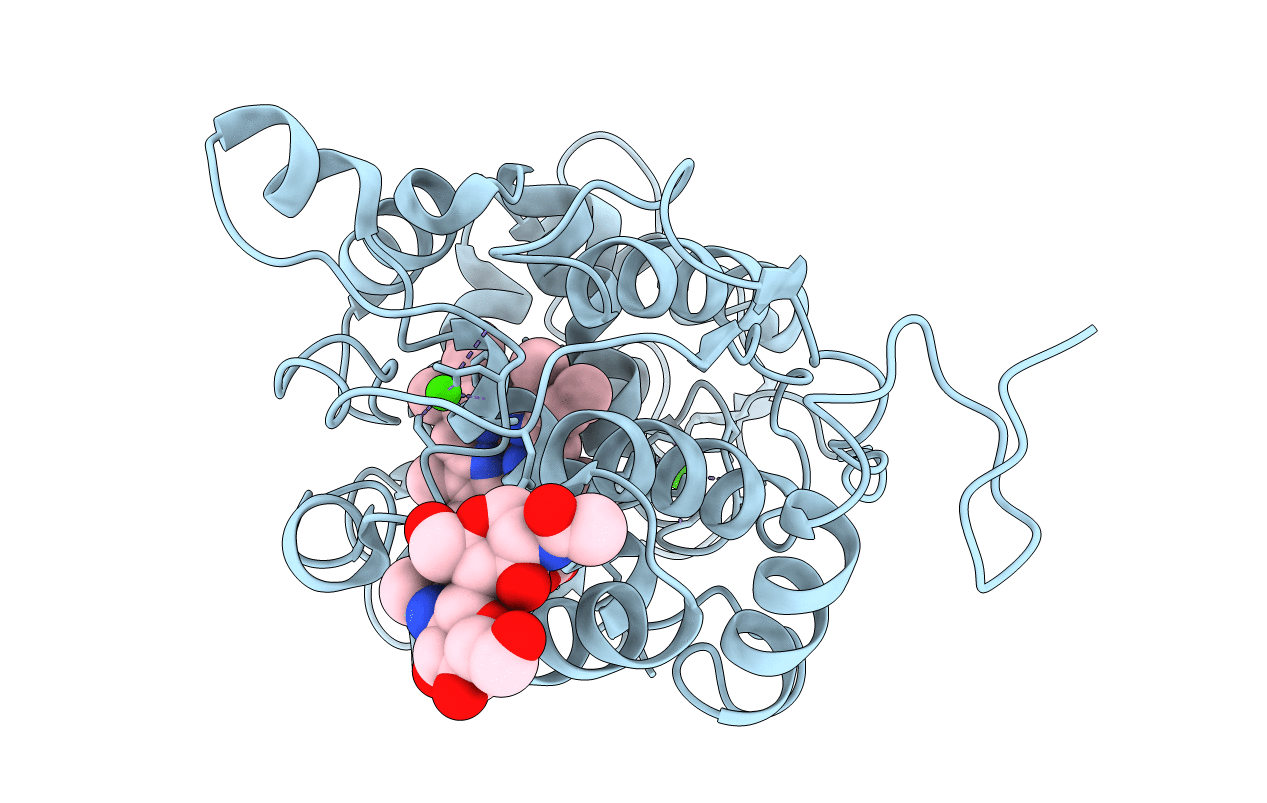
1ARP image
Deposition Date 1993-06-18
Release Date 1994-01-31
Last Version Date 2024-10-30
Entry Detail
PDB ID:
1ARP
Title:
Crystal structure of the fungal peroxidase from Arthromyces ramosus at 1.9 angstroms resolution: structural comparisons with the lignin and cytochrome C peroxidases
Biological Source:
Source Organism:
Method Details:
Experimental Method:
Resolution:
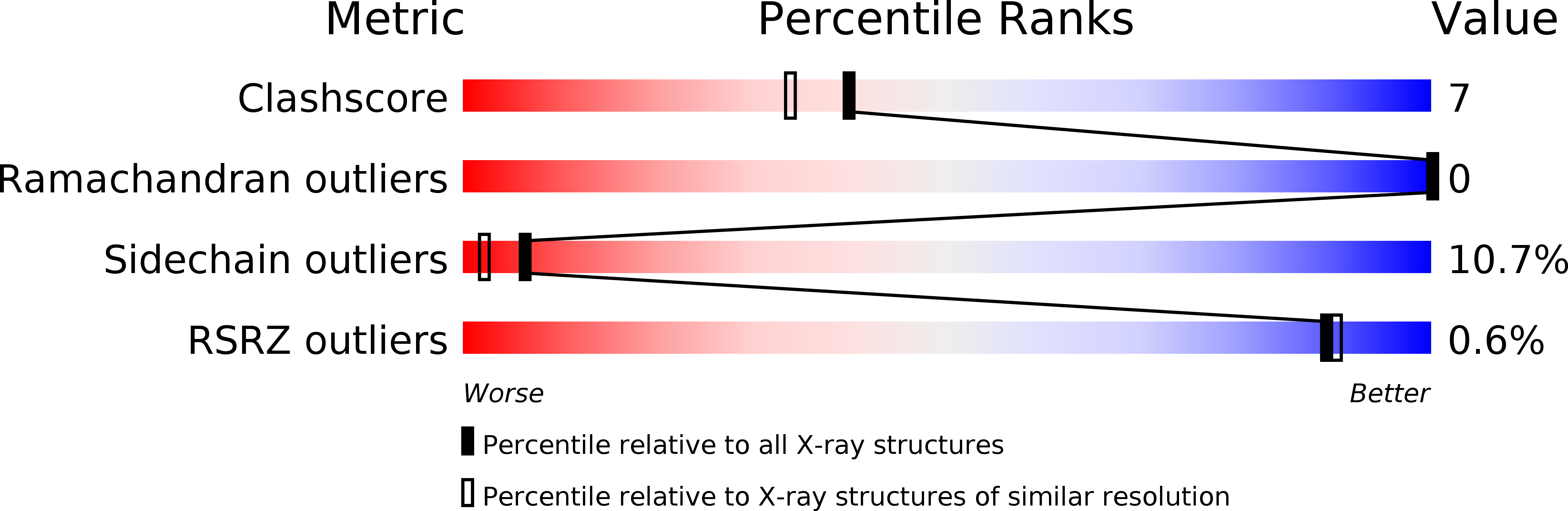
1.90 Å
R-Value Work:
0.17
R-Value Observed:
0.17
Space Group:
P 42 21 2
Macromolecular Entities
Structures with similar UniProt ID
Protein Blast
Polymer Type:polypeptide(L)
Molecule:PEROXIDASE
Chain IDs:A
Chain Length:344
Number of Molecules:1
Biological Source:Penicillium janthinellum
Modified Residue
Compound ID Chain ID Parent Comp ID Details 2D Image
ASN A ASN GLYCOSYLATION SITE
Primary Citation
Crystal structure of the fungal peroxidase from Arthromyces ramosus at 1.9 A resolution. Structural comparisons with the lignin and cytochrome c peroxidases.
J.Mol.Biol. 235 331 344 (1994)
PMID: 8289254 DOI: 10.1016/S0022-2836(05)80037-3

Abstact

The crystal structure of the peroxidase (donor: H2O2 oxidoreductase, EC 1.11.1.7) from the hyphomycete Arthromyces ramosus (ARP) has been determined by the multiple isomorphous replacement method and refined by the simulated annealing method to a crystallographic R-factor of 17.4% for the 19,191 reflections with F > 2 sigma F between 7.0 and 1.9 A resolution. The model includes residues 9 to 344, the heme group, two N-acetylglucosamine residues, two calcium ions and 246 water molecules. The root-mean-square deviation of bond lengths from the ideal values is 0.02 A. The mean coordinate error is estimated as 0.2 A. The electron density of the glycine-rich region of the amino-terminal eight residues was invisible. ARP has ten major and two short alpha-helices and a few short beta-strands. The overall tertiary structure of ARP is similar to that of yeast cytochrome c peroxidase (CCP) and is particularly similar to that of the lignin peroxidase (LiP) from Phanerochaete chrysosporium. Relative to CCP, ARP and LiP each have an extension of approximately 40 residues at the carboxy terminus. All eight cysteine residues in ARP form disulfide bonds (C12:C24, C23:C293, C43:C129 and C257:C322). Two calcium sites are inaccessible to solvent. The four disulfide bonds and two calcium sites, which are lacking in CCP, are conserved in ARP and LiP. The bond from Asn304C to Ala305N in ARP is the site sensitive to proteases. An Asx turn present in the Asn303 to Ala305 segment appears to orient the side-chain of Asn304 to outward from the molecule, rendering it easily trappable by pockets of proteases. The proximal heme ligand is His184 in helix F (distance of N epsilon 2 ... Fe, 2.10 A), and one of several water molecules in the distal pocket of the heme bridges the iron atom and the N epsilon 2 of His56. The orientation of the imidazole ring of the distal histidine residue relative to the heme group in ARP differs significantly from that in LiP. The access channel to the distal side of the heme of ARP is markedly wider along the heme plane than that of LiP. Many of the amino acid residues that comprise the entrance of this channel differ for ARP and LiP. This may account for the differences in substrate specificity.

Legend

Protein

Chemical

Disease

Primary Citation of related structures
Feedback Form
Name
Email
Institute
Feedback