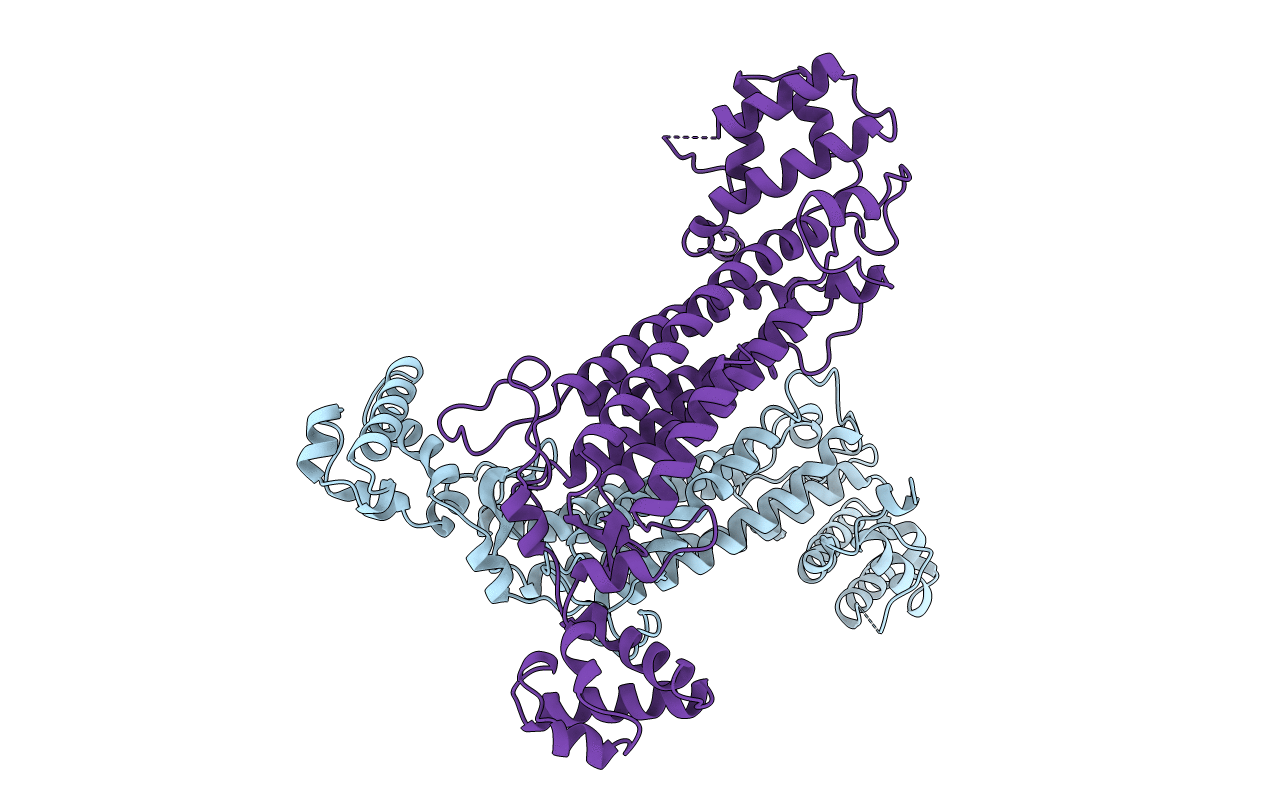
1AOS image
Deposition Date 1997-07-10
Release Date 1998-01-14
Last Version Date 2024-02-07
Entry Detail
PDB ID:
1AOS
Keywords:
Title:
HUMAN ARGININOSUCCINATE LYASE
Biological Source:
Source Organism:
Homo sapiens (Taxon ID: 9606)
Host Organism:
Method Details:
Experimental Method:
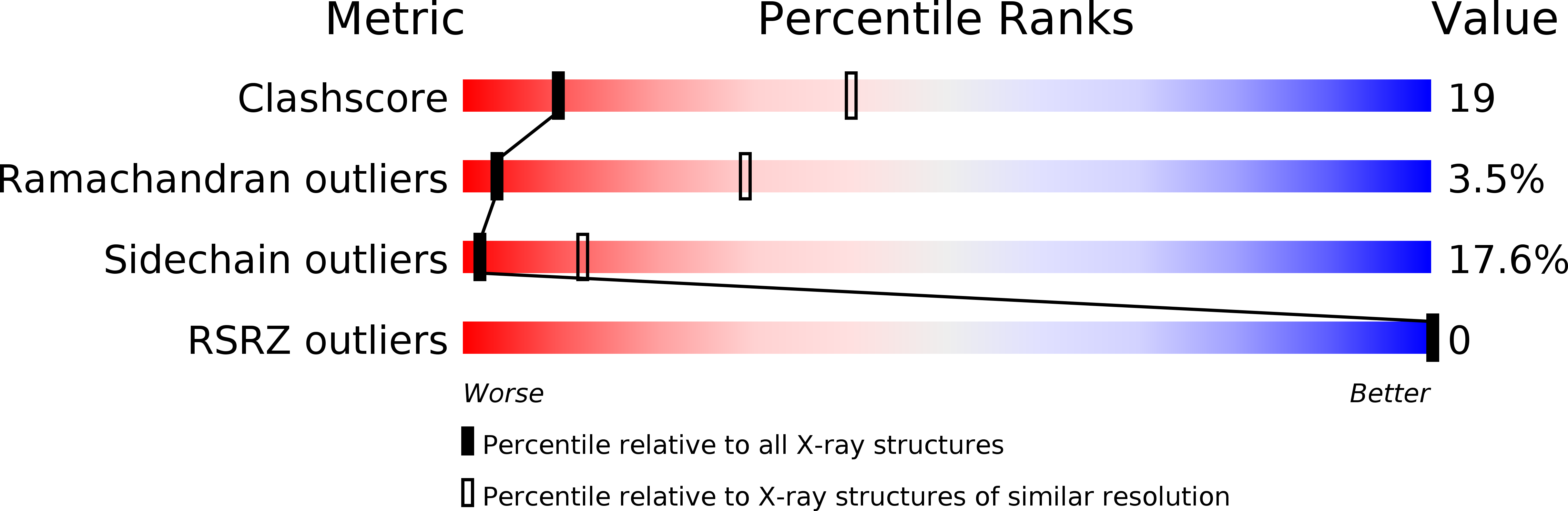
Resolution:
4.20 Å
R-Value Free:
0.29
R-Value Work:
0.18
R-Value Observed:
0.18
Space Group:
P 31 2 1
Macromolecular Entities
Structures with similar UniProt ID
Protein Blast
Polymer Type:polypeptide(L)
Molecule:ARGININOSUCCINATE LYASE
Gene (Uniprot):ASL
Chain IDs:A, B
Chain Length:464
Number of Molecules:2
Biological Source:Homo sapiens
Ligand Molecules
Primary Citation
Human argininosuccinate lyase: a structural basis for intragenic complementation.
Proc.Natl.Acad.Sci.USA 94 9063 9068 (1997)
PMID: 9256435 DOI: 10.1073/pnas.94.17.9063

Abstact

Intragenic complementation has been observed at the argininosuccinate lyase (ASL) locus. Intragenic complementation is a phenomenon that occurs when a multimeric protein is formed from subunits produced by different mutant alleles of a gene. The resulting hybrid protein exhibits enzymatic activity that is greater than that found in the oligomeric proteins produced by each mutant allele alone. The mutations involved in the most successful complementation event observed in ASL deficiency were found to be an aspartate to glycine mutation at codon 87 of one allele (D87G) coupled with a glutamine to arginine mutation at codon 286 of the other (Q286R). To understand the structural basis of the Q286R:D87G intragenic complementation event at the ASL locus, we have determined the x-ray crystal structure of recombinant human ASL at 4. 0 A resolution. The structure has been refined to an R factor of 18. 8%. Two monomers related by a noncrystallographic 2-fold axis comprise the asymmetric unit, and a crystallographic 2-fold axis of space group P3121 completes the tetramer. Each of the four active sites is composed of residues from three monomers. Structural mapping of the Q286R and D87G mutations indicate that both are near the active site and each is contributed by a different monomer. Thus when mutant monomers combine randomly such that one active site contains both mutations, it is required by molecular symmetry that another active site exists with no mutations. These "native" active sites give rise to the observed partial recovery of enzymatic activity.

Legend

Protein

Chemical

Disease

Primary Citation of related structures
Feedback Form
Name
Email
Institute
Feedback