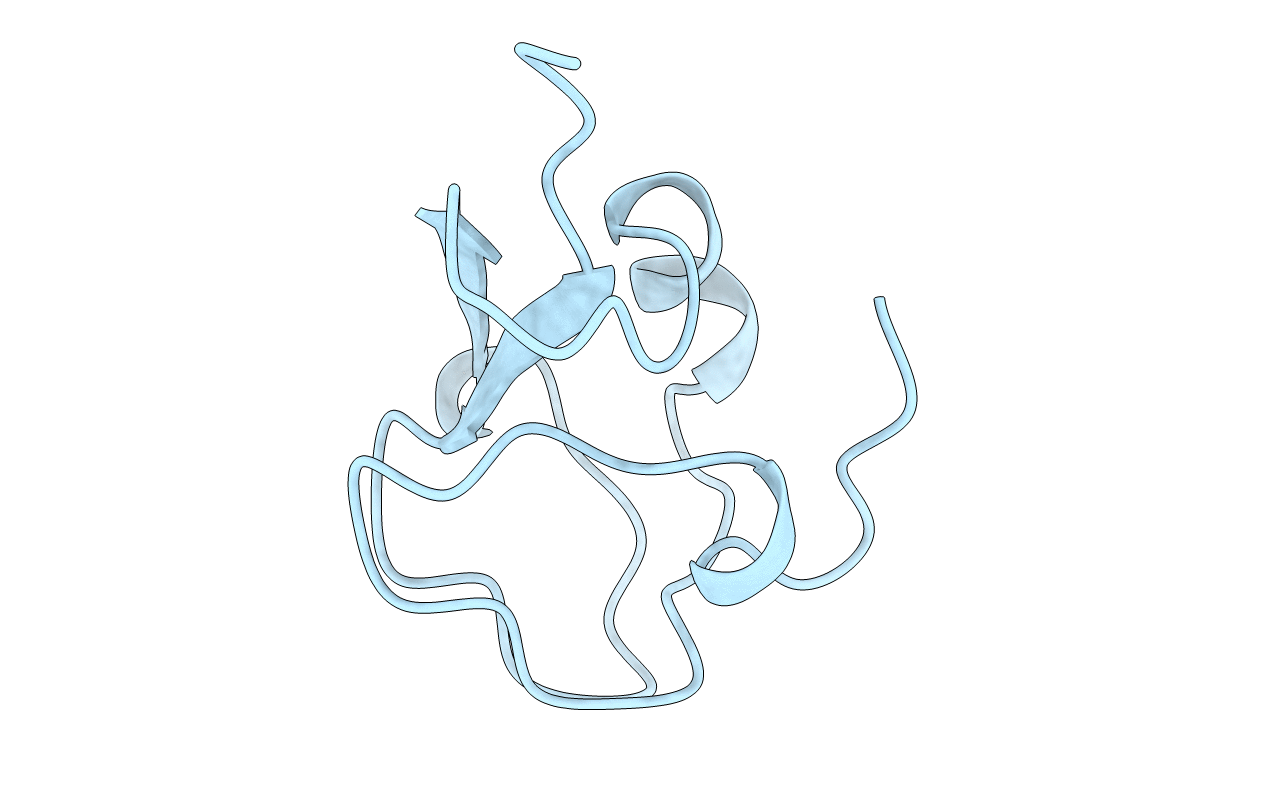
1AME image
Deposition Date 1997-06-13
Release Date 1998-06-17
Last Version Date 2024-05-22
Entry Detail
PDB ID:
1AME
Title:
CRYSTAL STRUCTURE OF TYPE III ANTIFREEZE PROTEIN AT 4 C
Biological Source:
Source Organism:
Host Organism:
Method Details:
Experimental Method:
Resolution:
1.65 Å
R-Value Free:
0.28
R-Value Work:
0.19
R-Value Observed:
0.19
Space Group:
P 21 21 21

Macromolecular Entities
Structures with similar UniProt ID
Protein Blast
Polymer Type:polypeptide(L)
Molecule:TYPE III ANTIFREEZE PROTEIN ISOFORM HPLC 12
Mutagens:INS(0), P64A, P65A
Chain IDs:A
Chain Length:67
Number of Molecules:1
Biological Source:Macrozoarces americanus
Primary Citation
Structure of type III antifreeze protein at 277 K.
Acta Crystallogr.,Sect.D 54 700 702 (1998)
PMID: 9761880 DOI: 10.1107/S0907444997020040

Abstact

Fish antifreeze proteins (AFP's) depress the freezing point of blood and other body fluids below that of the surrounding seawater by binding to and inhibiting the growth of seed ice crystals. The high-resolution crystal structure of type III AFP, determined at room temperature, reveals a remarkably flat surface containing most of the ice-binding residues [Jia et al. (1996). Nature (London), 384, 285-288]. Since AFP's function at temperatures close to 273 K, it is important to know whether the structure determined at room temperature undergoes any change at much lower temperature. Therefore, type III AFP has been crystallized at 277 K and its structure determined. Although crystallization conditions at 277 K were similar to those at approximately 295 K, crystal growth took much longer at the lower temperature. Crystals grown at the two temperatures were isomorphous. Initial crystals appeared within 40-50 d and grew to their final size in about 8-12 months, instead of a couple of days at approximately 295 K. The type III antifreeze protein structure from crystals grown at 277 K was essentially the same as that determined at approximately 295 K, with the exception of some minor changes in side-chain conformation. The result is an indication that temperature has a minimal effect on the structure of type III AFP, thus lending increased physiological validity to the room-temperature structure which was used for the initial ice-binding modelling.

Legend

Protein

Chemical

Disease

Primary Citation of related structures
Feedback Form
Name
Email
Institute
Feedback