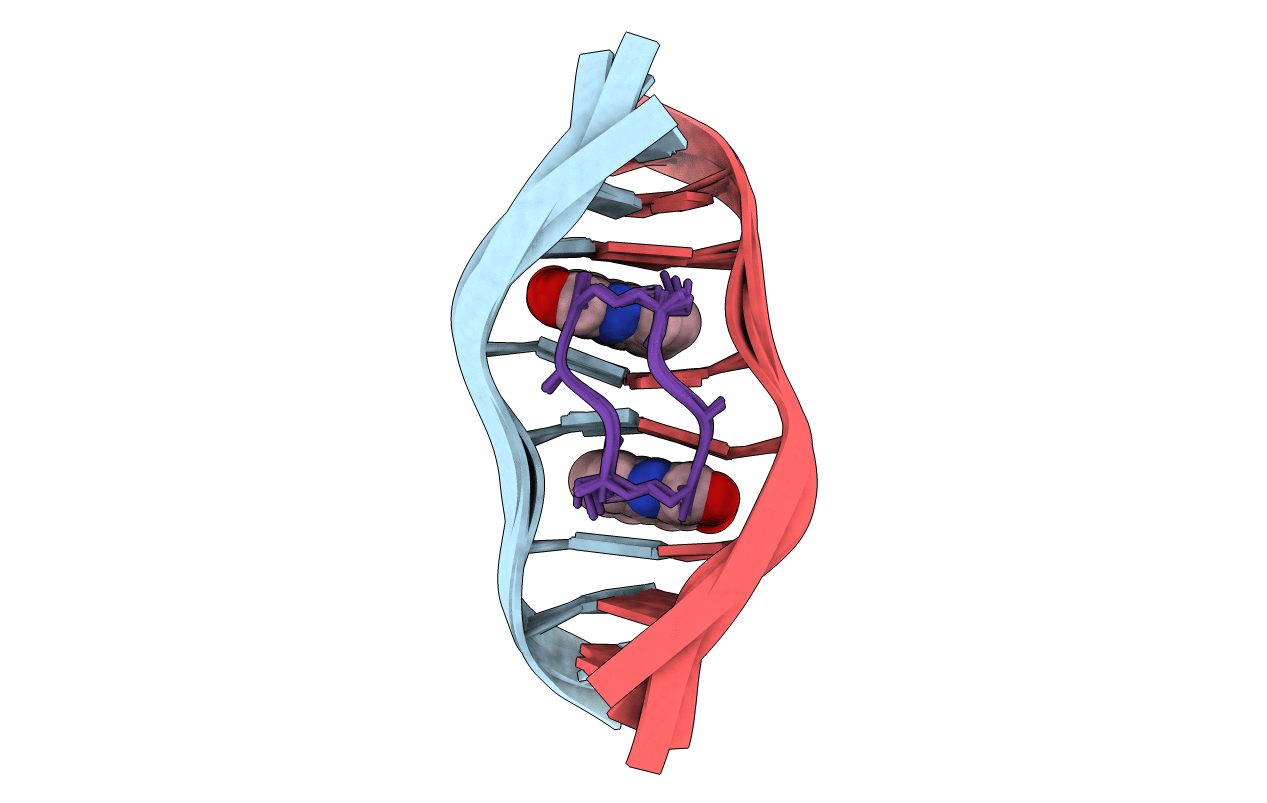
193D image
Deposition Date 1994-09-30
Release Date 1995-02-27
Last Version Date 2025-03-26
Entry Detail
PDB ID:
193D
Keywords:
Title:
SOLUTION STRUCTURE OF A QUINOMYCIN BISINTERCALATOR-DNA COMPLEX
Biological Source:
Source Organism:
Method Details:
Experimental Method:
Conformers Calculated:
4
Conformers Submitted:
4
Selection Criteria:
all calculated structures submitted

Macromolecular Entities
Polymer Type:polydeoxyribonucleotide
Molecule:DNA (5'-D(*AP*CP*AP*CP*GP*TP*GP*T)-3')
Chain IDs:A, B
Chain Length:8
Number of Molecules:2
Biological Source:
Polymer Type:polypeptide(L)
Molecule:QUINOMYCIN
Chain IDs:C
Chain Length:8
Number of Molecules:1
Biological Source:STREPTOMYCES
Ligand Molecules
Peptide-like Molecules
PRD_000492
Primary Citation
Solution Structure of a Quinomycin Bisintercalator-DNA Complex.
J.Mol.Biol. 246 164 ? (1995)
PMID: 7853395 DOI: 10.1006/JMBI.1994.0074

Abstact

The quinomycin antibiotic UK-63052 (designated QN) exhibits a chemical structure related to the antibiotic echinomycin which is known to bisintercalate into DNA. Common features among these antibiotics include two heterocyclic aromatic ring systems propagating from a cross-bridged cyclic octadepsipeptide scaffold. We report on the solution structure of the QN-d(A1-C2-A3-C4-G5-T6-G7-T8) complex (one QN molecule per duplex) based on a combined NMR-molecular dynamics study including intensity-based refinement. The 3-hydroxy quinaldic acid rings bisintercalate into the duplex at (A3-C4).(G5-T6) steps and stack with flanking Watson-Crick A3.T6 and C4.G5 base-pairs. The intercalation sites at (A3-C4).(G5-T6) steps are wedge-shaped and unwound, with significant unwinding also observed at the (C4-C5).(C4-G5) step bracketed between the intercalation sites. The cross-bridged cyclic octadepsipeptide is positioned in the minor groove with the methyl groups on its Ala and NMe-MCp residues directed towards and making van der Waals contacts with the minor groove edge of the duplex. A pair of adjacent intermolecular hydrogen bonds between the Ala backbone atoms and the G5 minor groove edge (Ala-NH to G5-N(3) and G5-NH2e to Ala-CO) account for the sequence specificity associated with complex formation. The solution structure of the QN-DNA oligomer complex, which contains only Watson-Crick base-pairs flanking the bisintercalation site, is compared with the crystal structure of the related echinomycin-DNA oligomer complex, which contains Hoogsteen base-pairs on either side of the bisintercalation site.

Legend

Protein

Chemical

Disease

Primary Citation of related structures
Feedback Form
Name
Email
Institute
Feedback