106D image
Deposition Date 1994-12-22
Release Date 1995-02-07
Last Version Date 2024-05-22
Entry Detail
PDB ID:
106D
Keywords:
Title:
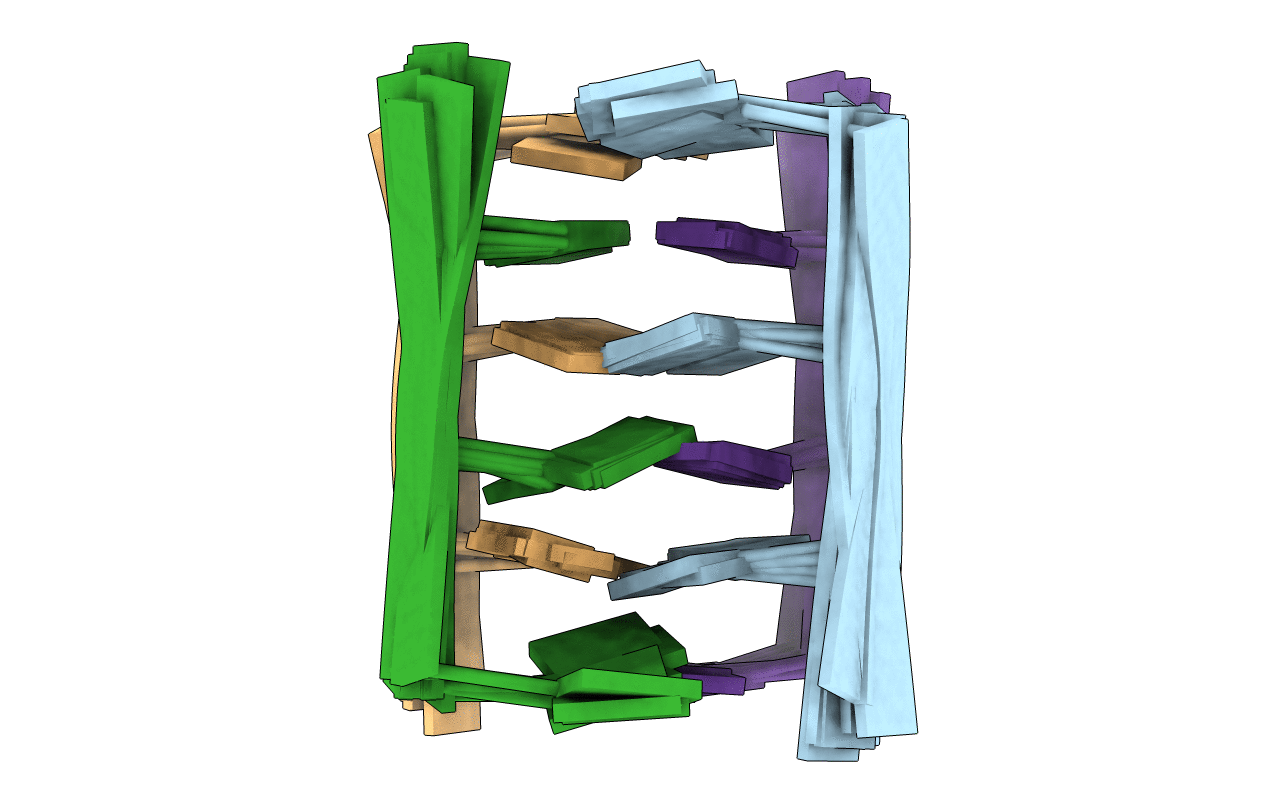
Solution structures of the i-motif tetramers of D(TCC), D(5MCCT) and D(T5MCC). Novel NOE connections between amino protons and sugar protons
Biological Source:
Source Organism:
Method Details:
Experimental Method:
Conformers Submitted:
8
Macromolecular Entities
Polymer Type:polydeoxyribonucleotide
Molecule:DNA (5'-D(*MCYP*CP*T)-3')
Chain IDs:A, B, C, D
Chain Length:3
Number of Molecules:4
Biological Source:
Modified Residue
Compound ID Chain ID Parent Comp ID Details 2D Image
MCY A DC 5-METHYL-2'-DEOXYCYTIDINE
Ligand Molecules
Primary Citation
Solution structures of the i-motif tetramers of d(TCC), d(5methylCCT) and d(T5methylCC): novel NOE connections between amino protons and sugar protons.
Structure 3 101 120 (1995)
PMID: 7743125 DOI: 10.1016/S0969-2126(01)00138-1

Abstact

BACKGROUND At slightly acid or even neutral pH, oligodeoxynucleotides that include a stretch of cytidines form a tetramer structure in which two parallel-stranded duplexes have their hemi-protonated C.C+ base pairs face-to-face and fully intercalated, in a so-called i-motif, first observed serendipitously in [d(TC5)]4. RESULTS A high-definition structure of [d(TCC)]4 was computed on the basis of inter-residue distances corresponding to 21 NOESY cross-peaks measured at short mixing times. A similarly defined structure of [d(5mCCT)]4 was also obtained. A small number of very characteristic (amino proton)-(sugar proton) cross-peaks entails the intercalation topology. The structure is generally similar to that of [d(TC5)]4. The sequence d(T5mCC) forms two tetramers in comparable proportions. The intercalation topologies are read off the two patterns of (amino proton)-(sugar proton) cross-peaks: one is the same as in the d(TCC) tetramer, the other has the intercalated strands shifted by one base, which avoids the steric hindrance between the methyl groups of the 5mC pairs of the two duplexes. CONCLUSIONS The structures obtained in this work and the procedures introduced to characterize them and to solve the problems linked to the symmetry of the structure provide tools for further exploring the conditions required for formation of the i-motif.

Legend

Protein

Chemical

Disease

Primary Citation of related structures
Feedback Form
Name
Email
Institute
Feedback