3E8L image
Deposition Date 2008-08-20
Release Date 2009-07-28
Last Version Date 2024-11-06
Entry Detail
PDB ID:
3E8L
Title:
The Crystal Structure of the Double-headed Arrowhead Protease Inhibitor A in Complex with Two Trypsins
Biological Source:
Source Organism(s):
Expression System(s):
Method Details:
Experimental Method:
Resolution:
2.48 Å
R-Value Free:
0.24
R-Value Work:
0.19
R-Value Observed:
0.19
Space Group:
C 2 2 21
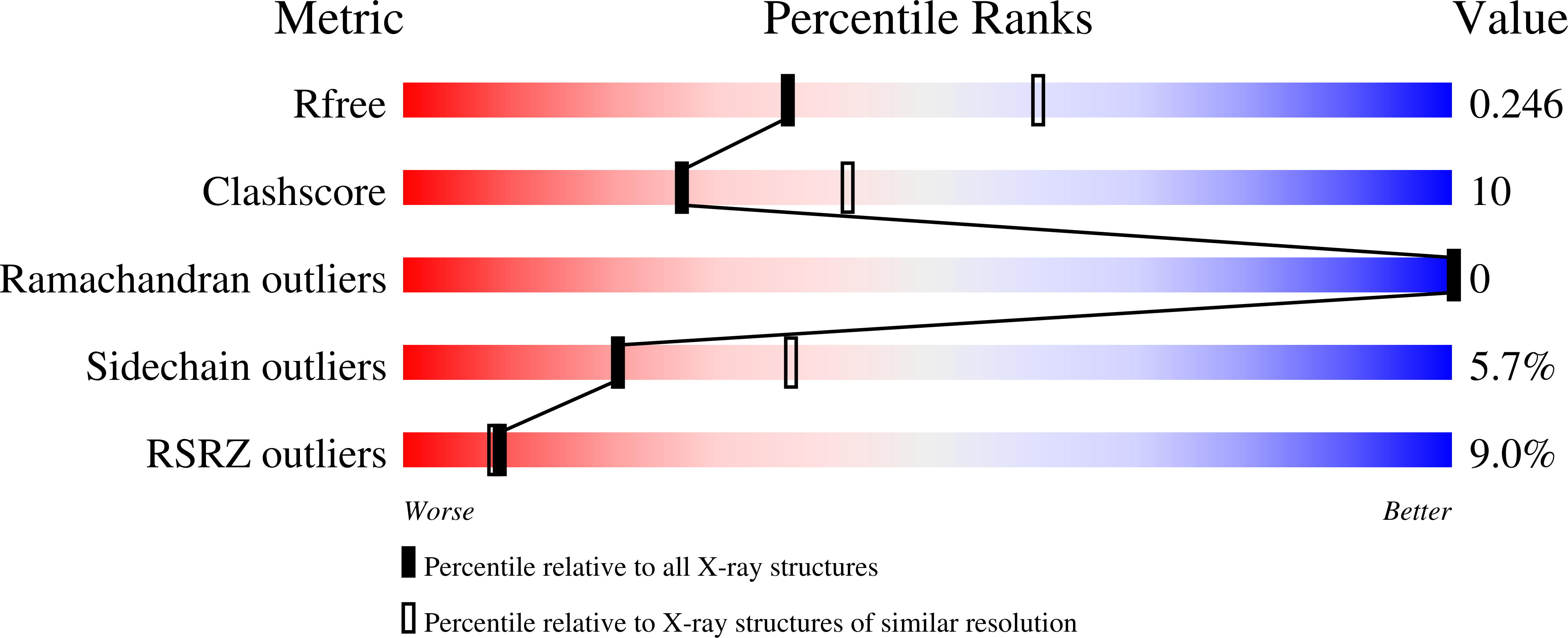
Macromolecular Entities
Structures with similar UniProt ID
Protein Blast
Polymer Type:polypeptide(L)
Molecule:Cationic trypsin
Gene (Uniprot):PRSS1
Chain IDs:B (auth: A), C (auth: B)
Chain Length:223
Number of Molecules:2
Biological Source:Bos taurus
Structures with similar UniProt ID
Protein Blast
Polymer Type:polypeptide(L)
Molecule:Serine proteinase inhibitor A
Chain IDs:A (auth: C)
Chain Length:185
Number of Molecules:1
Biological Source:Sagittaria sagittifolia
Primary Citation
The ternary structure of double-headed arrowhead protease inhibitor API-A complexed with two trypsins reveals a novel reactive site conformation.
J.Biol.Chem. 284 26676 26684 (2009)
PMID: 19640842 DOI: 10.1074/jbc.M109.022095

Abstact

The double-headed arrowhead protease inhibitors API-A and -B from the tubers of Sagittaria sagittifolia (Linn) feature two distinct reactive sites, unlike other members of their family. Although the two inhibitors have been extensively characterized, the identities of the two P1 residues in both API-A and -B remain controversial. The crystal structure of a ternary complex at 2.48 A resolution revealed that the two trypsins bind on opposite sides of API-A and are 34 A apart. The overall fold of API-A belongs to the beta-trefoil fold and resembles that of the soybean Kunitz-type trypsin inhibitors. The two P1 residues were unambiguously assigned as Leu(87) and Lys(145), and their identities were further confirmed by site-directed mutagenesis. Reactive site 1, composed of residues P5 Met(83) to P5' Ala(92), adopts a novel conformation with the Leu(87) completely embedded in the S1 pocket even though it is an unfavorable P1 residue for trypsin. Reactive site 2, consisting of residues P5 Cys(141) to P5' Glu(150), binds trypsin in the classic mode by employing a two-disulfide-bonded loop. Analysis of the two binding interfaces sheds light on atomic details of the inhibitor specificity and also promises potential improvements in enzyme activity by engineering of the reactive sites.

Legend

Protein

Chemical

Disease

Primary Citation of related structures
Feedback Form
Name
Email
Institute
Feedback