
Users
Projects
Studies
BioSamples
Experiments
Organisms
Datafiles
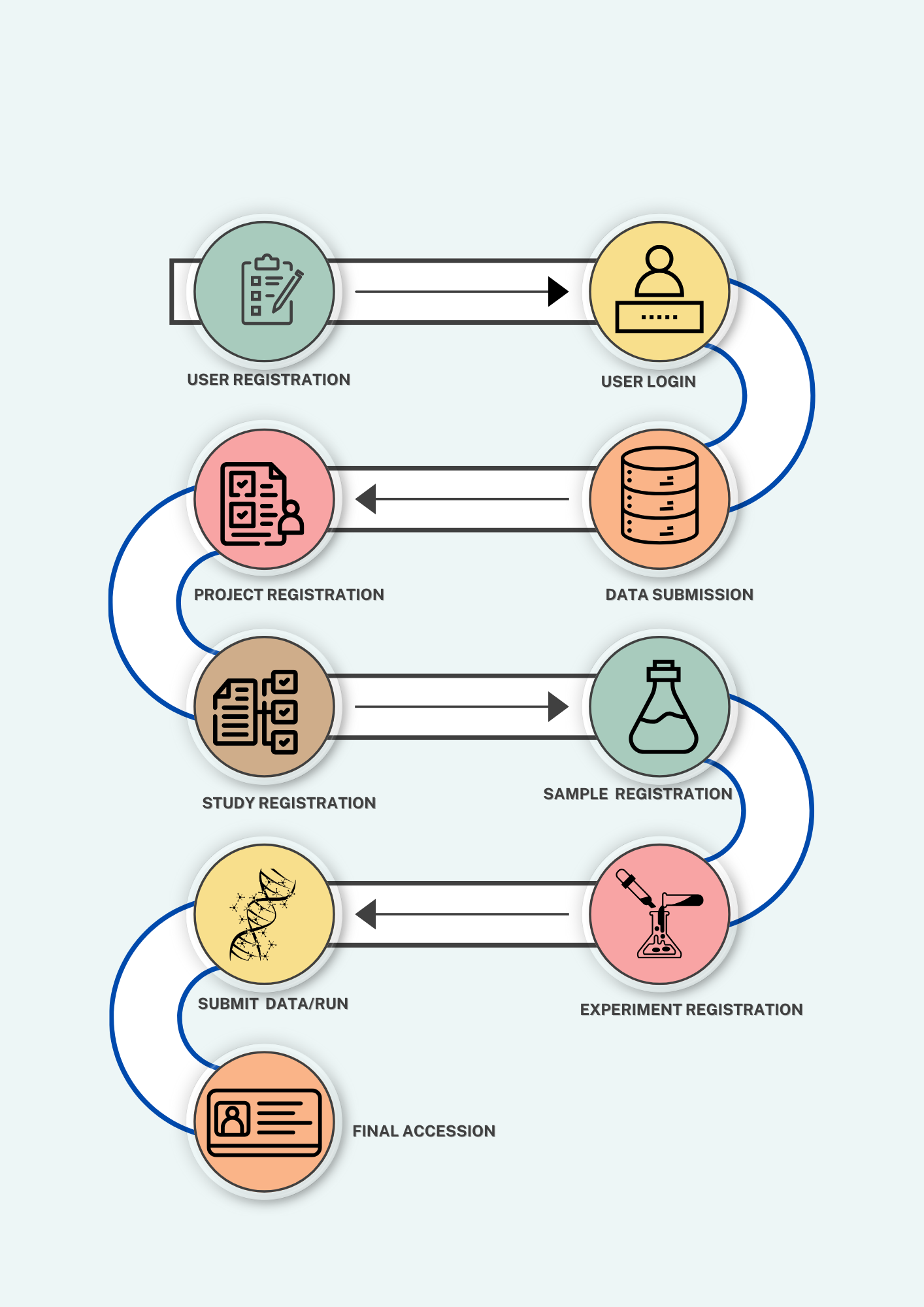
Prior to data submission, it is essential to complete the registration process on the IADA homepage by providing all required information. Once registered, an IBDC account will be issued. The credentials, including the username and password set during registration, will then be used for the submission of data.
Once registered, users can directly access the IADA submission portal by logging in with their credentials. Upon successful login, the user dashboard will display a summary of all previously submitted data, along with any ongoing or incomplete submissions.
The data submission section within the user's account provides options to submit functional genomic data. This includes the registration of key components such as the project, study, sample, experiment, and corresponding data files, ensuring comprehensive data organization and integrity during submission.
The project serves as a primary entity that organizes multiple related components and is the initial step in submitting data to IADA. Project registration requires the submission of basic details about the project, which form the foundation for subsequent data submissions.
A study is an entity that organizes related components and represents the second step in the data submission process, requiring the provision of essential information about the study. Data linked to a study remains confidential until the specified release date. This release date can be modified until the data is made public. However, once the data is publicly released, no further edits are permitted.
A sample contains detailed information regarding the biological source of the sequenced material and represents the third step in the data submission process. Samples are linked to predefined attribute groups known as checklists, which define the characteristics of each sample. Based on the sample registration form, users must generate a template and accurately complete it before finalizing the sample registration.
Experiment registration represents the fourth step in the data submission process. An experiment serves as an entity that stores comprehensive information about various experimental technologies, e.g. microarray, sequencing, and PCR etc. It also encompasses details regarding experimental protocols, instruments used, and library information.
A data file, or run, is a component of an experiment that contains processed genomic data, such as gene expression profiles. Data submission can be conducted via FTP-based methods, facilitating the transfer of large datasets to the repository for further analysis and integration.
The submitter will receive a unique accessions for each registered entity, from IADA.